
Posted: October 14, 2026
by A.J. Wells
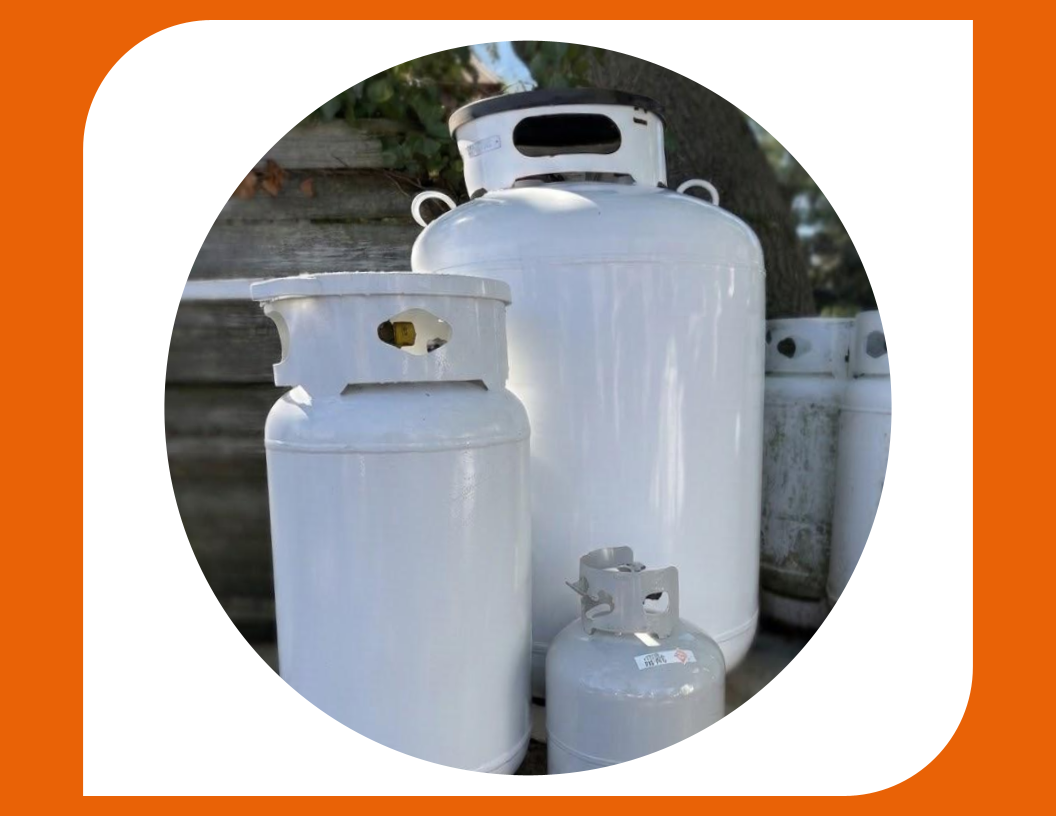
Propane gas has a wide variety of commercial, industrial, and residential applications. Accordingly, there are also a wide range of sizes for propane storage cylinders as well – from the common 20 pound grill tanks all the way up to a 420 pound (roughly 100 gallons of LP) vessel, propane gas storage is influenced by the amount of appliances on the system and the frequency of use. Propane cylinders are divided into two categories, named after the agencies that govern their use, testing, and manufacture:
That being said, there is overlap between the two. Some DOT tanks can be filled from a bobtail (but not all – it depends on the service valve that’s installed in the tank), and can be a similar size as their ASME counterparts. DOT cylinders are commonly referred to by the weight of propane that they can contain, while ASME tanks are usually referred to by the volume of liquid propane they hold. This can lead to a fair bit of confusion, as for instance, 100 lb. and 100 gallon tanks are vastly different sizes. So sometimes, you’ll hear a 100 gallon ASME tank referred to as a 420 lb. tank, or just a “420” – this helps clarify that the propane tank in question is the largest commonly-installed residential cylinder instead of a portable (albeit heavy) 100 lb. tank that gets filled at a local propane distributor.
Additionally, ASME propane tanks are also offered in larger horizontal arrangements (like a submarine) for both above ground and underground installations. This is a pretty clear indicator from the get-go for which style of tank is being discussed: if you see a large horizontal propane tank connected to a home, it’s an ASME tank. The only minor exception to this rule is that there are small horizontal DOT tanks as well, but unlike cylinders, there is no overlap in size between small (typically around 20#) DOT horizontal tanks that can be picked up by a person, and large (up to 1,000 gallon) residential ASME systems that require a crane truck for transport.
Due to their general nature, these two tank styles have different requirements for upkeep as well. DOT tanks require recertification starting 12 years after the date of manufacture, and every 5 years thereafter, while ASME tanks do not require any sort of recertification. This is due to both the style of construction and the nature of use – more things can happen to a 20 lb. grill tank that gets transported in the back of a moving vehicle once a month than to a stationary, unmoving 420 lb. cylinder.
It’s also important to keep in mind the systems that these tanks supply. Take the outdoor grill, for instance – these systems are typically engineered for the homeowner to make the connection themselves, featuring a rubber hose, inline regulator, and user-friendly “QCC1” handwheel implements that take tools and much of the risk out of the equation. Not all propane systems are as user friendly, and aren’t readily interchangeable. As a rule of thumb, any propane line or system connecting into a residence should only ever be manipulated or modified by a trained, licensed professional. Even though small grill tanks are designed to be connected by most competent homeowners, residential propane systems are not, and no part between the tank and the endpoint appliance(s) in the home should ever be disconnected or altered. Part of the reason is that if a residential propane system’s service is interrupted, a leak test is required by NFPA 54 for safety purposes, along with purging and relighting any and all pilots on the appliances in the home. This leak testing procedure is not a requirement for portable grills and other similar outdoor propane systems, which as stated before are designed with the end user making the propane connection in mind.
The final series of differences with these two cylinder styles are where and how they can be installed. If they’re getting filled from a bobtail, the clearances are almost identical for DOT and ASME systems, but there are some differences between the two for the required distance to crawlspace or other openings into the home, for example. Placement of permanently installed cylinders is an important consideration of how we design propane systems for our residential and commercial customers.
At Callahan’s, we know our cylinders. We know our tanks, regulators, and gas lines, too. If you have any questions about gas connections, line sizing, cylinder placement, or any propane safety concerns, we’re here to help. Contact us today to learn more.
