
Posted: November 25, 2025
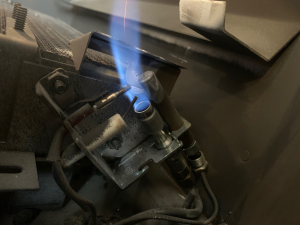
The fireplace pilot light is an integral component of gas hearth appliances. Back before the most common association with the word as it stands today (people who fly airplanes), the term “pilot” was originally used to describe something (or someone) that came before, to lead the path, and provide guidance for those that follow. Much like a pilot hole from a drill bit, a pilot flame ensures a safe passageway for the flow of gas into the burner assembly, and therefore ensures the safe operation of the fireplace as a system.
There are a multitude of different pilot light styles in the hearth industry, but at a fundamental level, they can be divided into two broad categories – ones having a standing pilot flame versus intermittent pilot ignition (which come on when the fireplace itself is turned on). There are exceptions to this simplified division, of course: manual pilot assemblies on one end of the spectrum (which are purely to provide a flame for the main burner to catch when the system is turned on, and have to be lit and engaged by hand), and direct spark on the other (a more advanced ignition method, wherein an ignitor sparks to engage the main burner directly – essentially skipping the traditional pilot sequence), but the majority of gas fireplaces in the country and here on the Eastern Shore fall into the first two categories. Each of these systems has its own inherent advantages and disadvantages, and whether you currently have a fireplace or are a future/prospective owner of one, understanding the pros and cons of the different ignition systems can be beneficial to your understanding of the fireplace system as a whole.
Standing (or millivolt) pilot systems are the simpler of the two categories. Typically, these are lit with two hands – one pushing/turning a knob to a “PILOT” position (which expels a small amount of gas through the pilot assembly), and the other hand clicking either an ignitor button or other source of spark to engage the flame. Once the pilot is lit, the knob will be held in for about 30 seconds to give the thermocouple (a small metal implement in the pilot assembly that produces small amounts of electricity when heated) time to warm up and “take over” for the knob being held in. The small amount of voltage produced by the thermocouple is what keeps the pilot flame on by electromagnetism – therefore, creating a self-checking system, meaning that if the flame is interrupted or turned off, the flow of gas will also shut off as well. Newer versions of these controls offer battery-assisted one-hand lighting, but ultimately, millivolt systems are lit by the homeowner or technician.
Intermittent pilot ignition (IPI) systems are a bit more modern than the previously covered millivolt style. When the fireplace is turned on by switch, remote, or Siri/Alexa, the pilot light is first lit through a series of sparks until the flame is established and confirmed (usually via small amounts of electricity that use the flame itself as a conductor to bridge the gap between two small metal rods). At this point, the fireplace module (the brains of the system, a small electronic chipset that controls the pilot, flame height, and other aspects/features of the fireplace as well) tells the main burner to engage, which uses the pilot flame to ignite the main burner flames accordingly. IPI pilots usually have the benefit of acting as always-on or continuous pilot (CPI) systems as well, which act similarly to the millivolt pilot systems – CPI modes can help a lot in extra cold weather to ensure the fireplace starts smoothly and quickly, and also help keep bugs/critters and dust from accumulating on and around the pilot assembly.
There are two main questions we get specifically about pilot lights, at two different times of year: “Should I turn my pilot off for the summer?”, usually in the late winter/early spring, and “How do I light my pilot?”, usually in the fall. It could be said that these questions are two ends of the same spectrum: while leaving the pilot on all summer uses more gas and slightly increases wear and tear on the pilot components which are being subjected to the flame, it greatly lessens the chances for nuisance outages or difficulties with lighting the pilot in the fall. If a technician is dispatched to a house to relight a fireplace pilot, the chances are that the cost of that service will be quite a bit more than the savings in gas that were had by turning the flame off for the summer!
Lighting fireplace pilots can (and will) be an entire post of its own, as there are many different manufacturers, styles, and techniques for turning them on, but they are fundamentally similar at a core level. No matter the shape, size, or gas type, we are equipped and ready to talk about, service, and work on your fireplace pilot lights all year round – reach out to us today to get set up for service or learn more about your fireplace!
