
Posted: September 16, 2025
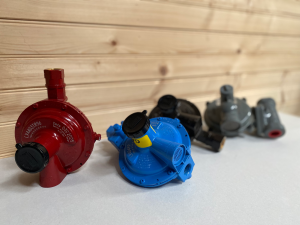
When a range, water heater, or fireplace is turned on, gas flows through the line to the appliance where it is ignited and burned. Getting from a frigid (-44° F) liquid state in the tank to a ready-to-burn low pressure vapor supply is quite a journey, and the process relies on propane gas regulators to ensure the right amount of propane gets to where it needs to be at the right time and right pressure.
In the tank itself, the liquid propane exerts quite a bit of pressure – depending on the temperature outside, this can range from 100 to 200 PSI! As gas is let out of the tank, the liquid boils (as long as the temperature outside is greater than -44° – usually not a problem on the Eastern Shore) and vaporizes to replace what is let out through the gas line. The first line of defense in lowering this immense pressure is at the tank itself. Much of the time, this is in the form of a bright red first stage regulator. This takes the pressure coming into it down from 100-200 PSI to a more consistent 10 PSI.
10 PSI is still considered high pressure, but it’s regulated, and won’t be affected nearly as much by temperature or tank percentage as the unchecked pressure coming from the tank itself is. This high pressure line is designed to be installed between the tank and the exterior of your house or business to the point of ingress, and can carry a lot of BTUs (British Thermal Units) in a small line size handily, which can feed a number of gas appliances. 10 PSI is only allowed externally to the home, and cannot enter into or below a structure for safety reasons.
Before the gas supply line goes into the structure, it needs to be regulated down one more time to low pressure. This is measured as 11 to 14 inches of water column – approximately .5 PSI. This is accomplished through a second stage regulator, which is usually installed at or around the point where the gas line enters the home. These are commonly brown, teal, or green, depending on the manufacturer – and are designed to accept only up to 10 PSI of inlet pressure.
If the tank is close enough to the house and/or appliances therein, another option is a two-in-one integral twin stage regulator. This acts as a first and second stage regulator in one. Many of our single appliance customers use this style of regulator – however, the further away the propane tank away is from the home, and the more gas appliances there are, the higher the likelihood a two-regulator system will be the best fit for your particular application.
Propane vapor undergoes a massive pressure change from being liquid in the tank at up to 200 PSI to entering your fireplace gas control at 11” of water column. To use the classic visual example of a football field, 200 PSI (if converted to inches of water column) would be longer than a standard football field, including the end zones, plus another 100 feet or so. In that same analogy, the low pressure gas lines in your home (at 11”) would still have to be measured by the chain crew. Regulators have quite the job to do!
Regulators, line sizing, and tank placement are all things we know, and love to talk about. Reach out to us today to plan your next propane gas installation!
